Tuesday, March 6, 2012

MOCHE 2 -- THE LADY OF CAO (a woman rules!):

This site, about 30 miles from Trujillo and called "El Brujo," was especially exciting because it turned out the tomb was that of a female, someone about 25 years old and someone who was a priest, a shaman, or a very influential governing person, given the artifacts found in her tomb.  Cool!  This discovery was made in 2007 and, at the time, the findings were likened to that of King Tut (the artifacts from the tombs of the Lords of Sipan have overshadowed the Lady of Cao tomb, however, but both sites and museums are amazing).  

the entrance
The view of the museum itself from the back as one leaves the excavation site 

The site itself contains 4 different sections, and the most-excavated place is called huaca cao viejo.  The overall name, El Brujo, is translated as "the witch doctor" because shamanic healing rituals were performed here for hundreds of years, and actually, they still are being performed.  The night before we arrived, a large group of Germans were there performing a ceremony, so we got to see the remnants of the ceremony because they had not taken down the stuff (the ceremony apparently concluded at 4 am).  

Imagine sitting on a couple of the posts, with candles glowing all around (there were dozens of them), on a clear and warm Peruvian night.  The thought of it is enough to cure one of whatever. . . . 
Not sure who/what this is, but it's apparently a necessary part of the ceremony. 
This is apparently the sacrifice platform -- used in the past for llamas, etc. (not people)
The ritual offering area.

 The Lady of Cao died around 400 AD, and the mummy seems to indicate that  she died in childbirth or shortly thereafter around 25 years of age. What is particularly amazing is that her forearms, ankles and fingers were tattooed with symbolic images of a spider, nocturnal animals and a serpent, all indications that she was a healer as well as the governing leader.


This is a representation of what this 25-year-old governing woman looked like, based on the mummy and on the artifacts which one can see in the museum (no pics allowed in the museo though).
Her tomb was below the wooden pieces, down several feet.
and in these squares were tombs of people sacrificed with her.  Julie noted that the male rulers who died always had their main wife and concubines sacrificed with them.  However, no male ruler husband was with her.  hmmmm  
This 6-minute video link shows the process of finding the mummy, moving it, and unraveling its contents:  http://www.go2peru.com/tru_brujo.htm (scroll down to the video).  What an exciting time!

Along with the mummy itself, there is also an array of pottery, gold necklaces, and other artifacts, as well as a ceremonial site which has some of the same wall pictographics as found in Huaca de la Lune, reinforcing the hypothesis that this culture was widespread and prominent. 

The graphic representation of how the site looked in 400 AD.
The various platforms tell the same story of the ritual warrior battles as we saw at Huaca de la Luna, and here is the platform with the warrior/prisoners tied together and walking up the ramp.  The basic difference is that these prisoners are larger and more lifelike.
Well, there is another difference.  Look carefully at these nude prisoners.  You may note that each of them has a rather pronounced erection, apparently occuring because of the drug they were given which stunted their mental sensibilities
but not . . . .
Here we have the platform with everyone dancing, again larger figures. 
A close-up of the dancer.  You will note that these dancers also had golden headdresses.
This is a wall of myth, also similar to the one at Huaca de la Luna -- not quite in such great shape though.  
And here we have the decapitator god depicted as a crab.  You can see the knife in his right hand.  The head, which would be in his left hand, is worn away.  
Notice the interlocking mud bricks which help create the solidness of the structure.  They also used columns of mud bricks here to guard against collapse when the earthquakes come. 
And, just as at Huaca de la Luna, archeological excavation continues here. 

More archeological excavation.
As the excavators dig, they also make mud bricks used to fortify the walls and to recreate the huacas.  
And if one takes a walk, one will find the ground littered with bits of ancient textiles (left arrow), shards of pottery (middle arrow), and bones (right arrow).
Julie & Harold are taking a break.  Join us tomorrow when we post a blog on the incomparable site of the Lords of Sipan. 
 And we will leave you with a poem, an ode written to the Lady of Cao:

An Ode to the Lady of Cao of Peru

By

The sun no longer strikes down on me
How close I was to life, how hard life was
How false ones gaiety can be.
Lonely at times:
Not in the soul
But in the sky of the mind!
My whole horizon ringed
With the morning birds;
I had a collection of things and people.
I have been a Queen, ruled the village of Cao
That was my love you see
Yet I did not live long--, twenty-five years is all.
Queen-chief they called me--,
My body tattooed to show such;
Bound in ceremonial wrappings...
Like a cocoon (a mummy)
Hence,
I was found in such garb.
Sorry to say, but I will:
I died from childbirth--
Buried in Trujillo--a thousand years ago!.
When I died..., then awake
It was like daybreak--I seemed to have
Had a sad feeling upon arrival.
Now harshly, all the sounds and voices
Of one moment to the next
Is simply fleeting.
Yet, up there I will never be again:
Still I hear my child's voice
From time to time..!
See Dennis' web site: http://dennissiluk.tripod.com/
Article Source: http://EzineArticles.com/?expert=Dennis_Siluk_Ed.D.

Monday, March 5, 2012

MOCHE 1 -- HUACA DE LA LUNA (Better than Egypt's Valley of the Kings?):

Is this site better than Egypt's Valley of the Kings?  It's close! 

Moche archeological sites and artifacts have been found in several places in northern Peru, but there are 3 main sites we would like to focus on in the next 3 postings:  
  1. Huaca de la Luna, 
  2. the Lady of Cao, and 
  3. the Lords of Sipan.  
These 3 sites, complete with wall paintings and pottery and tombs, provide an intriguing story of people in Moche (pre-Inca) culture and what they believed about life and death, similar to the stories we have learned about the ancient Egyptians in the Valley of the Kings.  
 
Also, these archeological sites poke big holes in the hypothesis that there wasn’t much “civilization” in the Americas previous to the coming of the Europeans.  The sites reinforce the theory that there were huge, thriving societies here.  

Although archeological sites exist that go back at least 5000 years before Christ, in these 3 postings, we will stick with an exploration of the Moche culture, a culture based in northern Peru from about the time of Christ to the 7th century.  It has only been in the last 20 years that archeologists have excavated some magnificent Moche sites and have learned much more about this culture, which some originally thought was little more than a blip on the societal map.

This indigenous group was massive in population, largely because their agricultural practices were so accomplished, including impressive and massive irrigation projects still in use today. They also were accomplished at crop raising and seed manipulation.  It appears, from what has been excavated so far, that the individual communities were all organized similarly:  a religious & ceremonial area (generally found in a hill because of the pyramid structure used), a political & administrative area (also a hill area) and a valley in between which consisted of the city itself.

HUACA (temple) DE LA LUNA -- one of the archeological sites: 

These three areas – the administrative/governing area (the largely unexcavated Huaca del Sol), the city itself (excavation just starting), and the Huaca de la Luna (some excavation completed but mostly still in progress) – are all aspects of a complex about 10 miles from Trujillo.  The Huaca de la Luna excavation was started around the 1990s.   The terms “sol” and “luna” are Spanish inventions, however, and there is no evidence of sun and moon worship in this culture.

What did the archeologists find?  Pyramids -- with all the different levels filled in with adobe brick, so the different layers are in good condition, with the relief wall pictorial representations in good shape, including the colors they used.  Each ceremonial court includes a pictorial representation of these aspects:  the battle between two groups of 10 warriors each, the 10 losing warriors being taken prisoner, the sacrifice of these 10 warriors, including the drinking of their blood  – all to appease their god:  Ai Apaec.

This is Cerro Blanco (the white mountain) that was deemed sacred, so Huaca de la Luna was built at the base of the mountain (lower left corner).
The ceremonial/religious center of Huaca de la Luna was constructed with mud bricks.  Each family was required to contribute so many bricks per year to aid in the construction (called the mita tax).  To assure that each family's bricks were counted,  each family had a "brand" which they placed on their completed bricks.  Here is an assortment of original mud bricks with their original brands.
The Moche were not ignorant of earthquakes, and developed a method of wall construction, using the mud bricks, which was almost impervious to earthquakes.  Note the columnar construction, so that the sections could rock individually and not knock down the entire wall.
This is an artist's representation of the entire ceremonial structure (at least what has been found thus far).  The large area is the court where the processions were held and where the people would gather.  At the right, you can see the various levels of the pyramid, with each level colorfully painted with the iconography of their belief system.  In the ceremonial court, you can see a small room in the upper left corner.  This was where the high priest would sit, in an all-white room, gathering the offerings from the people.  
This is a close-up view of the actual painted mud-brick wall, along with the priest's enclosure on the left.  Description of the various levels follows. 
These are the prisoners who, it is believed, were the "losers" in a ritual battle between 20 warriors (10 per side).  These losers became the prisoners, were striped, drugged, and tied together by the neck.  They were led up the ramp where they were sacrificed.  The blood was then drunk by the high priest -- all to assure the continuation of the culture, appeasing their god, Ai Apaec, who is both known as the "creator" god and the decapitator god (because of his role in beheading the prisoners).  See the very bottom picture to see a popular pictorial creation of this creator/decapitator.    
The next platform of paintings includes people dancing during the "celebration." 

Another platform contains geometric designs of the catfish (the black/gold pics) and the main god Ai Apaec, to whom the sacrifices were being made.
A close-up of Ai Apaec.
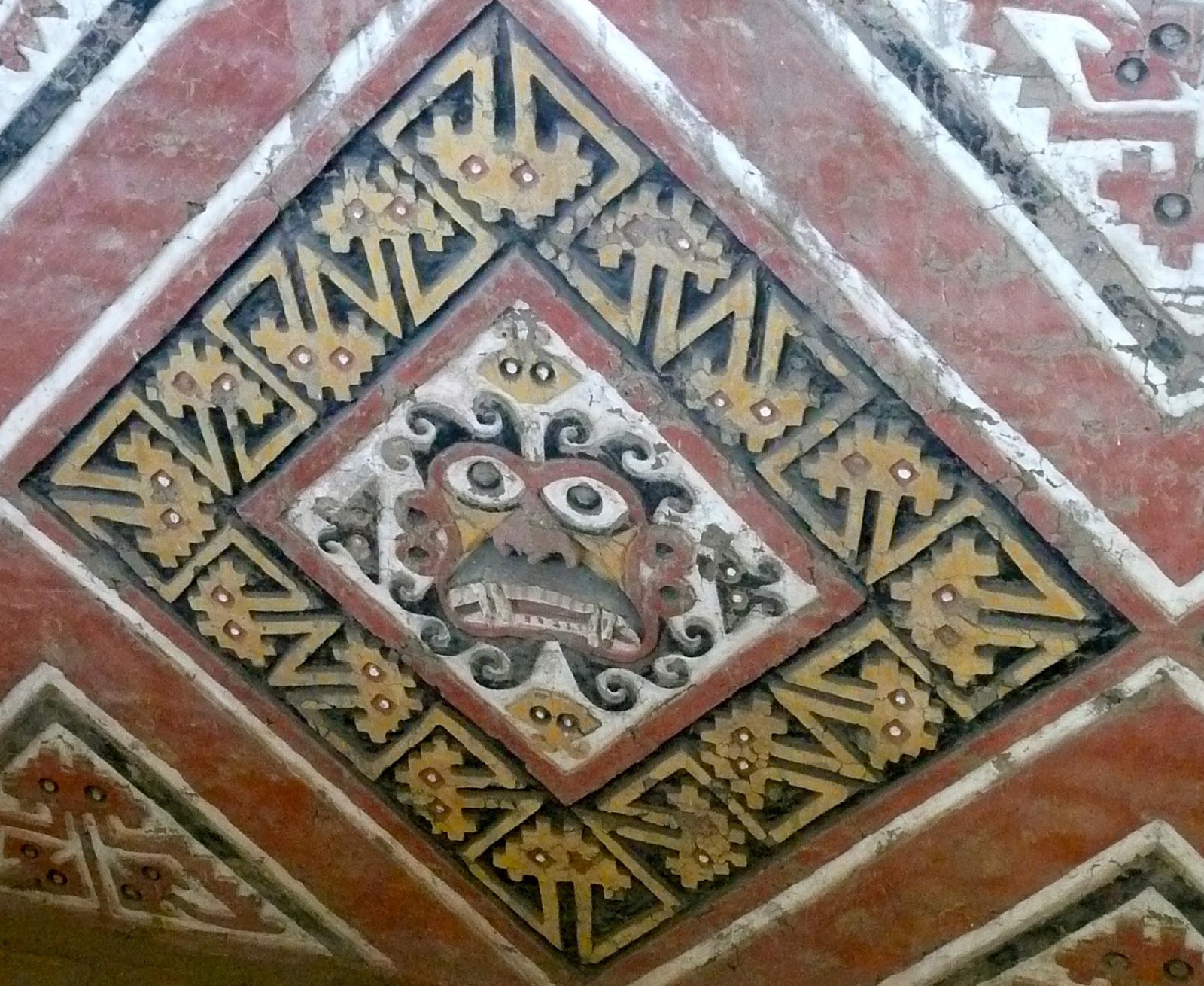
Another level holds paintings depicting the crab god, again part of the sacred iconography.  Note that the crab is anthropomorphized.
Another wall contains pictures of many of the myths that are a part of the belief system of the Moches.  This is a pictorial drawing providing a clear depiction of the wall, which you can see in its original form below.  If you are really into this stuff, you know what each little picture represents.
The wall as it appears today.  These walls are all in excellent condition because at some point, they were filled in 100% with mud bricks, perhaps when a ruler died and a new one took over, necessitating another pyramid.
They also found significant evidence of huaqueros (tomb raiders), but fortunately these huaqueros didn’t find everything, including some elements left in a tomb. 
See all those pock marks?  They are holes where huaqueros searched for artifacts.
Wait and see what they find at Huaca del Sol and in the community area between the two hills, which they are currently just starting to excavate.  Also, excavation continues at Huaca de la Luna.

Huaca del Sol (remember the name was provided by the Spanish).  It has been badly damaged, but archeologists hope to begin exploration on this administrative and political center soon. 
Exploration begins on the expanse between the administrative/political center (Huaca del Sol) and the religious/ceremonial center (Huaca de la Luna).  This area, the place where the people actually lived, should provide more clues about the life style of the Moche.


Oh -- and lest we forget, there's a good museum at the site, but one can't take pictures inside.  Here's a shot of the outside though.  Both Harold and Julie plan to keep track of this archeological site to see what they are digging up.  Exciting times for Peruvians!


One last rather gruesome item -- a popularized depiction of Ai Apaec.  This one comes from the wall of the entrance to our hotel in Chiclayo.  Here you see the creator/decapitator god with his decapitating knife in his right hand and the head of a warrior in his left hand.    


Come back soon for more about the Moches!


Sunday, March 4, 2012

A Journey Through the Night: the North Coast of Peru

We have returned from a trip to the North Coast of Peru to visit the sites of the pre-Inca regional cultures that existed there.  More on these cultures will be posted later, but let it be said now that the sites and sights are astonishing and amazing.

Our trip in a nut shell: We left Lima for Trujillo on the Monday night bus (nine hour ride) and we arrived in Trujillo for two days of touring archeological sites and associated museums. We spent two nights at the Libertad Hotel (very nice).  We then traveled from Trujillo to Chiclayo on a Thursday morning bus (3.5 hours) and spent that afternoon and the following Friday and Saturday morning touring.   We stayed two nights in Chiclayo at the Garza Hotel (so-so). On Saturday afternoon, we flew from Chiclayo back "home" to Lima.

An edited Google map showing Peru. Lima (the capital of Peru) is around 9 million people and the other major cities listed in official size are Arequipa, Trujillo and Chiclayo.  Each of these cities has about 1 million people if you include the surrounding areas.
The bus distance from Lima to Trujillo is 360 miles and from Trujillo to Chiclayo is 125 miles.  The landscape is all coastal desert.  The relief map on the right shows the Andes mountains almost going into the ocean, so the coastal desert is narrow. Rivers come from the mountains and pre-Inca irrigation canals turn the desert green. Sugar cane and rice are common crops. On our last two days in Chiclayo, the temperatures were 93 and 95 degrees Fahrenheit.

In a sense we have prepared for this trip for some time.  We have read Guns, Germs and Steel by Jared Diamond.  We have read 1491 by Charles Mann and recently read The Lords of Sipan by Sidney Kirkpatrick.   The Kirkpatrick book is a riveting read about the saving of one of the sites we visited from looters and smugglers in 1987.
The Enrico Poli Museum is within walking distance from our apartment. The museum is a private residence and features the private collection of the owner who is portrayed in the Kirkpatrick book as a criminal, a smuggler and one of the people who promotes looting of archeological sites. We perceived the man in the car in front of the house as a guard.  We did not visit.


Another museum in our neighborhood we visited prior to our tour was the Amano museum (great textile exhibits), and we saw a ceramic model made by the Moche culture of people on reed boats (note the little model in the upper left corner).  Julie exhibits good form on the real thing at the beach at Huanchaco outside of Trujillo, but note that she did not catch any fish.
 

 An example of irrigation and non-irrigation.  The little oasis contains the ticketing offices and some artesan shops that lead to Huaca de la Luna near Trujillo.


 A view of the desert on the way to Chiclayo from the bus window.


The smoke is from the burning of the sugar cane prior to havesting.  The view is from the top of Huaca de la Luna with some part of Trujillo in the background.
 
 Rice fields in the desert.
 We watched a horse riding and dancing exhibition in which the horses are one of the prides of Peru. The breed is known as the "Caballo de Paso," and they have been genetically bred to move with their legs on one side of their bodies and then the other.  The result is a very smooth ride. Here the horse and rider dance to music around the hat.

 The Peruvian hairless dog.  We saw a number of these.  The dogs were said to be a favorite of the Inca rulers. However, the lords of the earlier cultures had a royal spotted dog that is thought to be extinct.
 The cathedral on the main square of Trujillo. Some 15 years ago, the mayor decided that the buildings around the square should adopt the colors found in the nearby archeological sites - red, yellow, blue.... The abandonment of good old white caused quite a controversy - but it was done. Note the sheen on the concrete walks. Often this is a smooth finish - makes us nervous when we walk on it.
 The public library in Trujillo. We did not visit inside - but we sure liked the outside.
 Our excellent English speaking guide Patricia in Trujillo led us through a colonial house once used by Simon Bolivar (the George Washington of South America).  The ceilings in the rooms must be 20 feet high.
 Harold has been to Purgatory which is a high point at a site where 26 mud-brick pyramids had been built. Most have not yet been excavated.

Actually, Julie has been to Purgatory also.  Here we take a break and enjoy the breeze at the top.  We also watched the buzzards sailing around.

A welcome sign into the city of Chiclayo. The mural on the sign depicts the saga about how the Lambayeque culture was started by a group of people emerging from the sea on rafts.  The saga was recorded by a Spaniard in early colonial times.  We found all the people in northern Peru to be very welcoming.


Stay tuned for upcoming blog entries on the pre-Inca archeological sites we visited.