Tuesday, February 21, 2012

Ever wanted to live on a house boat? Well, how about living on floating reeds in the middle of a lake?

In the midst of Lake Titicaca, we had the fortune to see a lifestyle that is truly amazing–Islas de los Uros.   The Uros people, who originally perhaps fled from the Spanish who forced the indigenous people to work in the silver mines, live on floating reeds anchored to the lake bottom.  We kid you not!  They now live together in small family units (about 5 or 6 families per island), and there about 50 islands on which these small community units are living. 
the island we visited

the women on the island we visited
 Here is the process that they go through to build their own island:
(1)  they go to a location close to where they live in a shallow area of Lake Titicaca.  There, they cut off large pieces of congealed earth which they then pull over to their chosen island location. They tie them together and anchor them securely to the lake bottom.  These floating pieces of earth act like a cork to form the base of their island. 

a small cross section of the floating cork-like base of each island
(2)  Once the base has been established, they lay pieces of tortora reeds in one direction, then the other until they have a reed depth of about 2 feet.  This is the base of their island.

a small example of the way the reeds are laid on top of the "cork"
(3)  Once they have the island, they begin building reed houses (bedrooms), a reed kitchen, reed boats, and everything one would need to live, including a small trout farm pond in the middle of some of the islands and potato patches built up from the reeds in a raised garden.

the bedroom huts

a trout pond in the middle of one of the islands
(4)  Soft spots on the reed base occur every year or so, and when a soft spot appears, they cut off that section and redo the entire process (get a new “cork” base, place new reeds, etc.)

On each island, about 5 or 6 families live together in their bedroom huts with doors facing each other.   Each island has a leader, and there is also an overall leader of all of the islands.  If families on a particular island do not get along, they begin by placing the doors of the reed huts on the opposite sides so they aren’t looking at each other all the time.  If that doesn’t work, the island leader will decide what to do, and often the island is cut apart (literally, with a saw) and the belligerent family will have to move and connect itself it another reed island and another small community.  

There is no running water, but they do have solar panels, and some families have small TVs.  There is a school on one of the islands, a bank (complete with an ATM), a post office, and even a 7th Day Adventist Church.  They go into Puno once a week to trade and buy the other necessities they need for living.   They sell fish and birds that they trap, and sea weeds are a part of their diet, but they mostly make their living through the tourist industry.

a bird which they have caught and dried
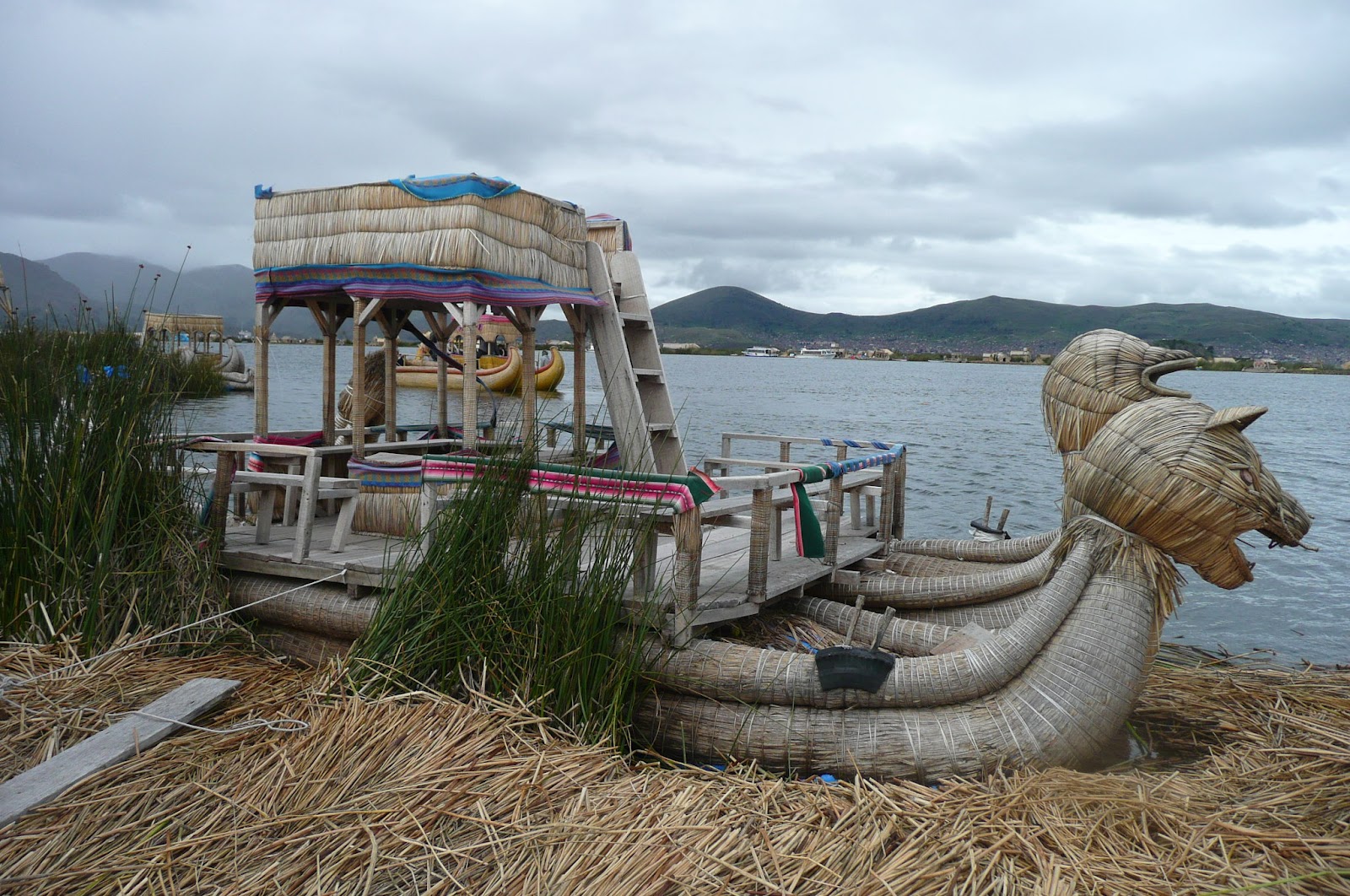
and they build these kinds of boats, using the same reeds and plastic bottles (inside the runners) for buoyancy.  They use these reed boats for inter-island transportation, to get to the mainland, and to give tourists rides from one island to the next. 

The young adults cannot intermarry within the same island (they know about in-breeding and genetics).  Once a couple gets married from two different islands, the couple moves to the island of the male partner.  

Walking around is squishy and damp (I was amazed that they were mostly barefoot, and my feet were freezing), and there is a distinct moldy smell permeating the atmosphere.  Those negatives asides, the islands and the lifestyle of the Uros truly are amazing.

Harold and Julie as temporary members of the Uros culture

the Litchys and the Rodakowskis having a good time on the reed islands

Monday, February 20, 2012

Quick Trip Report

We have returned from a trip to Colca Canyon and Lake Titicaca and feel the need to make a quick report on the trip.  We made this trip with friends, Bill and Pat, and had a great time. However, we cannot report on any depth on the six-day trip and all the things we saw and experienced, so this report is a picture review - no depth but some things we saw.  

We had been experiencing high rain, so our original plan to approach Colca Canyon from the west and go east was thwarted by mud and rock slides. Plan B was to go over a route that Julie and Harold had traveled before - i.e. traveling to Chivay and entering the canyon from the east.  This may sound somewhat disheartening, but we experienced good weather throughout our trip and the touring was excellent.  

We had the assistance of our driver Edgar and guidance from our English-speaking guide Lizzie - so here are some pics!
We spent the first day visiting sites in Arequipa - the Cathedral, Santa Catalina Convent, the Jesuit Church, and the Juanita Mummy Museum. Some shopping was done and a break was needed.  During that break, Bill visited with El Ekeko at a local bistro.

A trip around the city of Arequipa along with a visit to the Mansion of the Founder and the colonial era water mill preceded the trip to Colca Canyon. On the way to Colca Canyon, we passed through the National Reserve and we saw huge herds of llamas and alpacas.  Note the water!

Arrival at Cabanaconde and the start of Carnaval was in progress. Julie and Bill joined in.

A view or the mountains from our Cabanaconde hotel Kuntur Wassi.
Up and ready to go after a hearty breakfast at Kuntur Wassi.
Julie and Harold at the San Miguel Mirador (view point) with the Canyon as a drop back.

Bill takes a break and admires the view.  We all suffered a bit from the altitude and had to do things with some ease.

The terracing that has been done was a never-ending source of amazement. Our guide told us that about 15% of the terracing is being used today.  This terracing was built prior to the Incas.
A cliff cemetery that we viewed at Mirador Choquetico.  The Collagua culture (pre-Inca) lived at the top of the prominences and buried their dead on the cliff sides.

In the village of Maca, Julie and Pat met a Black-Chested Buzzard Eagle and became instant friends.

The Collague culture used these cliff side granaries to store their seeds.  These granaries supplied the right temperature and humidity, and they were safe!

The current farmers were picking peas - by hand.  Here was a result of their handwork waiting to be picked up by the cooperative truck.
The taxis waiting in Yanque.  These are motorcycles with two wheels and seats in the back. They seemed usable and economical.

The local weekly market in Chivay was visited, and here we saw freeze dried potatoes that are said to be good for 25 years. No mechanical refrigerators are used as high altitude drying and cooling is available.

We stopped at 16,000 feet at the pass over the mountains on the way to Puno, the town on Lake Titicaca.
Yareta is plant that from a distance appears to be a moss growing on some rock. The plant is an evergreen perennial, has pinkish flowers, grows very slowly, and some of the plants are over 3000 years old. It grows close to the earth to conserve heat and at altitudes of 14,000 feet.  Our guide said that the locals use yareta to aid in diabetes treatment.
The vizcacha is to the right of the two plants and in front of the boulder.  This rodent is the ecological equivalent of the rabbit in North America. It looks like a rabbit but has a long bushy tail and is related to the chinchilla.

One of the reed boats (actually aided with plastic bottles for more bouyancy) by the Uros people who live on the reed islands on Lake Titicaca (altitude of about 12,500 feet).  More on these islands in an up-coming blog posting.
A reed house sitting on a reed island.  The islands are made on "peat moss slabs" about six feet in thickness that are floating in the water (somewhat anchored) and are covered with reeds.  The islands last about 25 years, but the reeds need to be replenished periodically.
After a boat ride of about two hours on Lake Titicaca, we visited the Island of Taquile, and we had lunch at this gentleman's restaurant/house.  Among a variety of things, he demonstrated a natural soap used to clean sheep's wool.

After our visit on the Island of Taquile, we walked down to the harbor to meet our boat.
The stone tombs at Silllustani were first constructed by leading families/clans of a pre-Inca culture. The tombs had a small entrance placed at the bottom so good spirits could exit and enter.  When the Inca followed, they continued the practice but with improved stone work.  The stone tombs, known as chulpas, were positioned over looking Lago Umayo, because the area was deemed sacred. The remains of a temple to the sun and moon have been found on the flat island in the lake.  It was good to be interred on sacred ground.


The "farmsteads" in the area around Sillustani seem to be well built and unique.  The pottery bulls are meant to give thanks to nature and to seek good luck for the family.

Farming has challenges in the high plateau (Altiplano), and in this case, the challenges of excess water and low temperatures are addressed with broad ditches with the water giving off heat when the temperatures lower significantly at night.
It was a great week with Bill/Pat.  We were so glad they could come.

Sunday, February 19, 2012

Some Incan mythology connected to our travels: Colca Canyon (condors) and Lake Titicaca (the birthplace of the first Inca King)

One of our goals for this trip to Peru is to “finish” the Incas.  We certainly aren’t becoming experts, but we have learned much about the Incan culture, both its good and bad points, and about the fascinating indigenous pre-Inca cultures.  More about those pre-Incan cultures later.

Today, we are going to pull together some pictures and tidbits about the mythology surrounding the “birth” of the original Inca, made all the more special because we are at the birthplace location with good friends Bill and Pat Litchy.  Additionally, we will learn more about the sacredness of the condor.  

First, the condors: 

The condor, the largest bird in the world with a wingspan of over 10 feet, held special significance for the Incas.  The bird soars to impressive altitudes (6000 meters) and it is a scavenger; thus it is identified by the Andean people as the guardian spirit of the dead, and since it eats everything dead, it is considered to keep the world clean and free of disease.  In the past, for example, when enemies were killed, the bodies were placed ina location where the condors feed, and the condors would clean the land of the enemy bodies and spirits.   

In ancient times, the condor was believed to be the messenger of the Sun because the majestic bird was responsible for carrying the spirits of the dead to the next world. 

Adding to its intrigue for the Andeans, the condor lives in the cliffs of the highest mountains where tradition says that apus, the guardian spirits, live.  The condor represents the apu, the good spirit of the mountain.

The condor is visible on much of the pottery of the Incas, and it can be seen as artistic representations in the form of cities, terraces, and mountain forms (for example, The Condor Mountain and the town of Pisac).  The city of Puno also has a huge statue of the condor, as do many of the smaller communities, such as this one is Cabanaconde:

On to Lake Titicaca, the birthplace of the Inca:


A caveat:  there are several variations on creation myths, and each indigenous group seems to have its own variations.  Thus, you hear many stories.  Just roll with it. . . .

In the beginning, a being called Viracocha (“Creator of All Things”) created a world with no sun, moon, or stars, so the people lived in darkness.  These people were supposed to live without vices, but they didn’t follow his advice.  The result?  Viracocha got rid of them all through various methods including a flood – a uñu pachacuti, meaning “water that overturns the land” (it supposedly rained for 60 days and 60 nights).  This flood created the great Lake Titicaca, and it was there that Viracocha created the rising sun, the moon, and the stars to provide light over his new landscape.

The sun jumped up to the sky from a large island in Lake Titicaca called Isla del Sol, where in the rocks, one can see the sun's footprints, placed there because of the gigantic force the sun used to jump into the sky.  The moon got into the sky from Isla de la Luna, a smaller island next to the Isla del Sol.   On Isla de la Luna, there are the ruins of an ancient convent called Ailla Wasi (House of the Chosen Women). 

Isla del Sol
After surveying his empty land, Wiracocha ordered the sun to send a son (Manco Capac) and the moon to send a daughter (Mama Ocllo) to emerge from the waters of Lake Titicaca.  They walked across the waters of the lake until they reached land.  
  
Thus, the Inca considered this lake to be a part of their sacred, foundational landscape -- the MamaCocha. It also explains why there is a huge sculpture of Manco Capac at Parque Huajsapata.

Note that the Inca also holds his golden staff and points in the direction where they will walk, heading toward the location where the golden staff will easily plunge into the earth, thus showing them where to place their kingdom.  
Viracocha gave Manco Capac a golden scepter and told him to walk to the northwest and wherever the scepter could be placed easily into the ground, Manco should found the Inca culture.  The soft land was found by Cusco, which you'll learn about in a later posting.  Stay tuned!  


Thursday, February 16, 2012

It's raining; it's pouring: drain spouts in Arequipa -- the simple to the sublime

In the US, our drain spouts all look the same -- metal or plastic tubes running along the sides of the houses generally in the same color or a color that matches the siding of the house or trim.   BORING!

The drain spouts in Arequipa are often architectural wonders, and we think the US ought to take some lessons from the Peruvians.  

Here are some examples from the simple to the sublime: 

This one gets the job done, but that's about it.

This one is in the middle of the wall.  Not too decorative but at least at attempt was made to have it blend in.

Again, your basic model.

The cannon model.  I don't think I'd want to be under this one if it started raining.
A variation on the cannon model, this one with a flower at the very end -- perhaps to soften the blow.
Perhaps this is the same carver, one who likes flowers.
Next, we have some examples which are ornate and which have a variation of facial expressions on the spitting spouts.

This one is gonna blast it.

Oh dear, he seems to say.

Here's a cute gent walking right down the wall, or so it seems.

This one actually pours into a wash tub.

I suspect, though, even with all the variation, the effect is the same:  you don't want to be caught under a drain spout if it's raining!