Friday, January 13, 2012

Julie Heads to the Convent (Harold follows)

The largest convent in Arequipa is the Santa Catalina Convent, a part of the Dominican order (formally called Monastery of Saint Catherine or “Monasterio de Santa Catalina”), which opened to the public in 1970 after being restored after the two devastating earthquakes of 1958 and 1960 largely because the nuns couldn't afford to fix it themselves; they needed the tourist income. We were again amazed at what people in a specific culture will accomplish in the name of the religion they profess.

This particular convent started in 1579, 40 years after the Spanish arrived in Arequipa.  It is huge, covering 4.94 acres, having its own streets and often being called a “city within a city.”  Making it additionally beautiful is its construction from sillar, the white volcanic rock that gives Arequipa the name of the White City, and ashlar, petrified volcanic ash from Chachani, the mountain which overlooks the city.


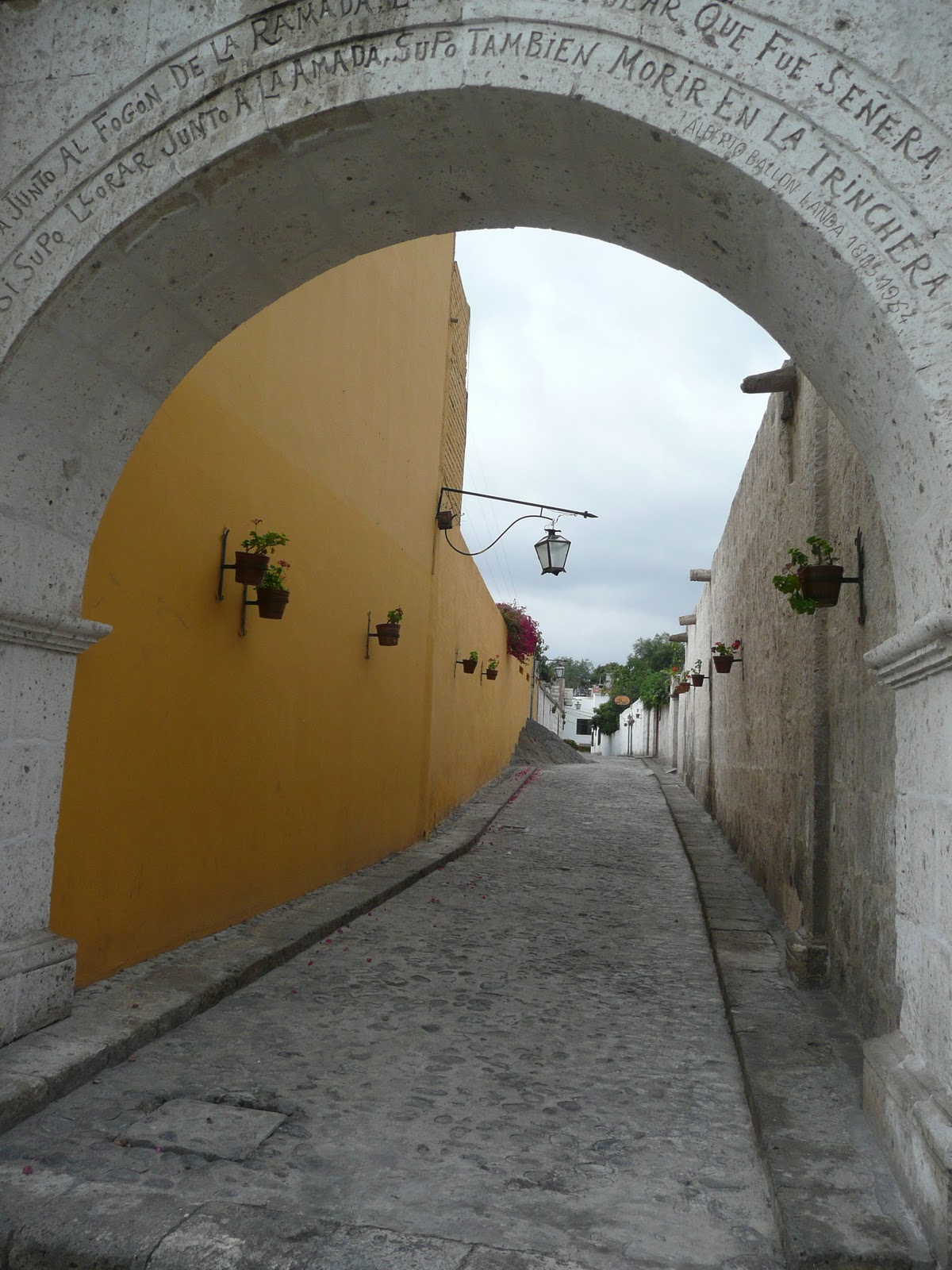
Here's one of the beautiful streets reminiscent of Spain with hanging geraniums on one side. Newer architecture on opposite side houses new quarters for the nuns (Yes, the convent still has nuns, but only 23 of them).
While the architecture is delightful to walk around, what is most interesting is its history.  It was founded by a rich widow from Arequipa, and it was an upper-class monastery, only accepting girls from the wealthiest families who had to pay a significant “dowry” to get the girls in, as well as a yearly fee – sort of a female country religious club for the rich.  The “dowry,” in fact, was 2,400 silver coins, equivalent to about $50,000.  But there was more!  They also had to bring with them 25 things, including a statue, a painting, a lamp and clothes. Some also brought the finest English china and wonderful silk curtains and rugs (many of these items are on display in the convent museum).  


But wait!  There’s more!  The families built houses for each of them, consisting of a main sitting and sleeping room for the nun, a kitchen, and the quarters for their personal servants (1-4 of them per nun).  A few of these "homes" are also visible.

Here is a pic of one of the nun's beds.  Notice the curved sillar arch over the bed.  Architects have learned that this curved structure is the strongest in case of earthquake:


The second daughter of each wealthy family was targeted to become a nun, and often left home at the age of 3 to study at the convent before becoming a noviatiate.  But don’t think they just sat around praying all day – such was not the case.  They were able to invite musicians to perform, have parties, and live in the style they had been accustomed to – without leaving the grounds and without seeing their family except on special visiting days when the family would be on one side of this wooden screen and the nun on the other.  They could talk to each other, somewhat see each other, but not touch. 


At its peak, the convent contained 450 people, about 1/3rd of whom were nuns, the rest servants.  The only male allowed to enter was the doctor, and he wasn't around very much.
In 1871, this good life came to an end when the pope sent a strict Dominican nun to enforce the vow of poverty and thus send the dowries back and free the servants (some say slaves), giving them the choice to leave or become nuns themselves.  At that point, the convent was opened to women of all social classes.

During our tour, we walked through narrow streets named for cities in Spain, passed through arched colonnades with beautiful paintings at the tops of the columns and around the top, viewed courtyards, fountains, flowering plants and trees, the chapels, the kitchens, the laundry area, and, of course, some of the “home” of the nus who lived there.

Here are some of the pictorial highlights:

Cloister of the Oranges:  The three crosses set among the orange trees are the center of the Passion of the Christ ceremonies when the monastery is closed to visitors:

The servants needed a place to bathe, so this "tub" was built for them (I suspect it was lilyless when they used it!):

One of the beautiful gardens: 

 Laundry Area: Big earthen storage vats served as wash tubs when canals provided Arequipa’s water supply.  Each type of clothing filled a different pottery vat, and the water was directed to each pot by use of a rock gate (second pic):


And the artwork is stunning.  Here we see artwork at the top of one of the columns, but there were also numerous oil paintings, many of them brought by the nuns themselves:
:

Oh – here’s one more nun we should mention: Sor Ana de Los Angeles Monteagudo (1595-1668).   She first entered the convent as a 3-year old, spent most of her childhood there, refused marriage, and returned to enter the novitiate. She became known for her accurate predictions of death and disease. She is credited with healings, including the severely inflicted painter who painted the sole portrait of her. It is said that as soon as he completed the portrait, he was completely healed. In her later years, Sor Ana was blind and in ill-health and when she died in January of 1686, she was not embalmed because her body did not reek of death. She was buried under the floor of the Choir in the church.
When she was exhumed ten months later, her body had not deteriorated, but remained as fresh and flexible as the day she died. She is credited with healing others, even after death. The nuns wrote reports at the time of instances where the sick were healed after touching her possessions. Shortly after her death, petition to name her a saint was submitted to the Catholic church. In the way of the church, the process is slow. It wasn't until 1985 that Pope John Paul II visited this monastery for the beatification of Sor Ana.  (Sister Ana info from gosouthamerica.about.com).
She is now on the docket for sainthood, so stay tuned. But also stayed tuned, because they were making a documentary of her life when we were there (maybe to come out at the time of her officially becoming a saint?).

The door to her room:

Her bed:

A room with her personal items in tribute to her:

Sister Ana's death carriage and artifacts about her life:

The guy in this pic was filming a documentary about her.  The oil painting he is filming is about her life: 

 We have several convents to go. . . . .


Thursday, January 12, 2012

Arequipa and Countryside Bus Tour

On Tuesday, January 10, we hopped on a bus for a 4-hour long tour of the area.   It was a gorgeously sunny day, and thankfully, the bus had a double deck with a sun screen over the top deck.  The guide switched between Spanish and English in her explanations.  The entire tour would be too long and detailed for this blog, so only selected photos will be shown.

The tour began at Plaza de Armas (blue square in the above map), then to Mirador de Carmen Alto, Yanahuara, etc. (in other words counter-clockwise.) The red dots is where stops were made and the blue dots identify geographical points we passed through.


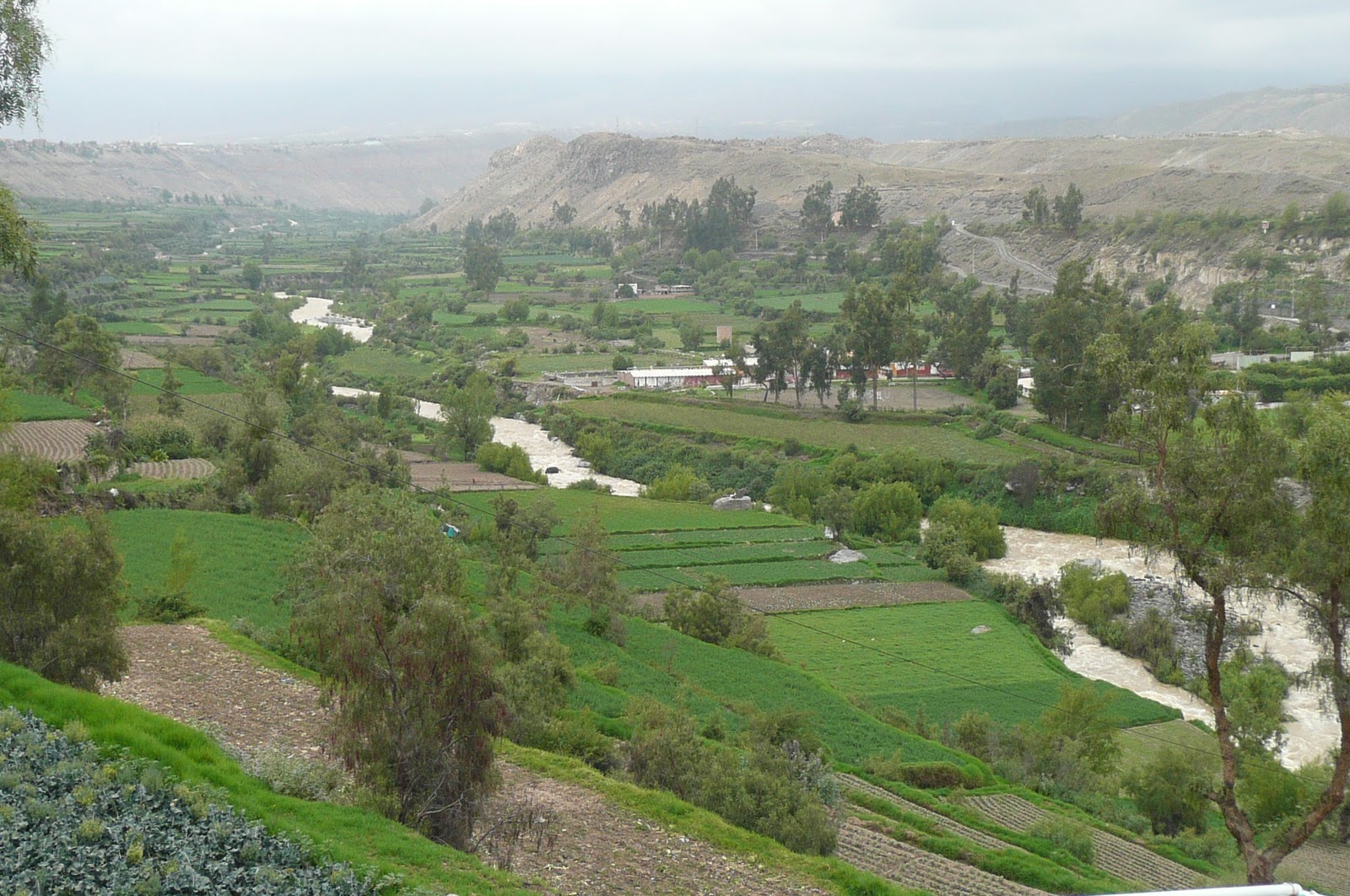
The first stop, Mirador de Carmen Alto, was a view of the Rio Chili and the terraces that have been built and used since the pre-Inca era (amazing!).  There is little agriculture that is not irrigated in the area. A closer look at the canals and ditches that bring the water from a higher point in the river to the fields down river and the gates to manage the water would be interesting.  One can only imagine all the disputes that must have emerged as the system was developed.


At Yanahuara we viewed a street built to look like a street from a city in Spain.

At Incalpaca we enjoyed watching a vicuña and then a guanaco, and Harold even purchased an alpaca vest.  Julie tells Harold that he cannot drink beer while wearing this vest.
The vicuña has the finest wool, and in Inca times only the royalty could wear clothing made from the vicuña.

The guanaco is a territorial animal and to the unwary or those not listening to the tour guide, the guanaco would spit on those that were too close to his fence.  This was somewhat humorous, especially since it was not either of us who was spit upon. The guanaco have not been domesticated.
A view of a shanty town (a "new town") as we passed near Huasacache.
Harold at the entrance to the colonial era house  built by the Spanish founder of Arequipa. The town was founded in 1540, and the founder was the "governor" and became very wealthy (along with all the rest of the Spaniards who came to Peru).
The entrance into the interior courtyard of the Masion del Fundador was made large enough so the home owner could ride into his house on a horse.  The ironwork above the gate contains the initials of the founder GMC (Garcí Manuel de Carbajal).
 A water filter. The filter is volcanic rock - the water does pass through, one drop at a time.  It takes 6 hours to produce one liter of filtered water.
The rushing water that still runs a grain grinding mill at the mill at Sabandia (Molino de Sabandia).
At the end of the tour the shadows were becoming long. However, the pre-Inca terraces were still impressive.


A great tour!


Wednesday, January 11, 2012

Achieving an Arequipa Acquaintance

Max, our landlord at our Bed & Breakfast, is originally from Switzerland (Peruvian wife), and he met us at the Arequipa airport to take us to our new abode.  Our present intent is not to remain here for our entire stay in Arequipa.  We shall see.  We receive our breakfast, and we have been taking our dinners here.  Max is a hobby chef, and makes great meals, so if we leave, we'll definitely miss his cooking.  Overall, our current experience has been good.   Internet connection has had some problems, but currently seems stable. The B&B is a bit out of the central district as we have found that some taxi drivers cannot recognize our location.


The locals have been stating that the weather has been too rainy, and our first two days featured cloudy weather, but yesterday was sunny with temperature in the low seventies. So yesterday was when we had breakfast on our terrace with the following views.
 Our breakfast is served and note the background.
This breakfast view is of Chachani with an elevation of 19931 feet.  This morning we watched the farmers work two of the fields. Note the fields are terraced!  More on that later.  The city of Arequipa has an elevation between 7600 and 7700 feet, and we have been careful not to be too strenuous during our first days here so that we don't suffer from altitude sickness.  We think we are now acclimatized.


This view is of El Misti with an elevation of 19110 feet.  Of the adjacent volcanoes, it is the one that most recently erupted (1700s).  Misti is considered a unique volcano as the cone has not collapsed into itself. There is a third volcano called Pichu Pichu that is to the south of us, but it is difficult to take a good picture facing into the sun.  This trio of volcanoes is well known when Arequipa is portrayed.


We have walked to the central district, and the area has much to explore.
 We had lunch in balcony restaurant and took these pictures of Plaza de Armas (Plaza of the Armed Forces) which is the main square of Arequipa.  In the above picture you see the cathedral made from volcanic rock (sillar) and the rock, and the resulting buildings are noted for their whiteness.  Below you see the active lunch crowd.

We have also become familiar with the Chili River (Rio Chili) which travels through Arequipa from North to South and receives its water from the mountains.  We have found that the farmers use the waters extensively.
Rio Chili
Yesterday we took a tour of the city (a bus tour with an English speaking guide), and the tour was over four hours long.  The results of that tour will be addressed in other blog postings.


That's it from Arequipa, Peru today!

Monday, January 9, 2012

A Visit to Lima

Too short of time was spent in Lima, Peru.  We spent three nights and two days and that was simply not enough.   Lima is a huge city – people say 10 million people out of a country of 30 million. We spent most of our time in Miraflores and visited San Isidro and the downtown neighborhoods which are upscale neighborhoods.  Our very nice hotel (AnTara) is in Miraflores and has a good location.   We walked to the nearby cliffs to view the Pacific Ocean and perused the mall perched on the cliff (Larcomar).  The hotel is next to a very nice grocery store with ATMs (a necessity). 

We chose to go on arranged tours – the first tour on Saturday afternoon (Jan 6) was a city tour, and we re-visited the view of the Pacific, viewed a pre-Inca mud brick pyramid (Huaca Pucllana), drove through the up-scale community of San Isidro, visited the main plaza in the center of Lima and visited the Church of San Francisco and the associated catacombs (amazing!).  Pictures were not allowed in the catacombs where over 25,000 people are thought to have been buried.

The 2nd tour on Sunday morning was a tour of two museums:  (1) the National Museum of Archaeology, Anthropology and History of Peru and (2)  the Larco museum.  Both museums were excellent, and we could have spent much more time there. We were fortunate that our tour guide’s group was only two people (us!).   The collections illustrate the richness and diversity of cultures before the Incas.  The pottery, textiles (truly amazing!), silver and gold metal work were well represented.  As we approached the last collection in the Larco museum, our guide said that the collection needed no explanation and left us.  We were puzzled but entered the world famous erotica pottery collection where seemingly anything related to the topic was vividly shown (in pre-Inca pottery).  Examples of the various collections can be viewed at this web site
 

by choosing the gallery selection menu.

We extended our day by having the tour driver leave us at the museum for Huaca Pucllana (the mud brick pyramid), and we were able to view the exhibits with a tour guide and walk to the top of the pyramid.  The area around Lima is a flat desert, so the people built a high place for their ceremonies and celebrations out of mud bricks.  Seventy per cent of the pyramid is original, and since the desert receives less than a inch of rain per year, erosion is not a severe problem.  But earthquakes are a problem and that is the reason the “book shelf” style of brick laying was done. The design seems to have been effective as the walls have been standing for centuries.

From the pyramid we walked back through a very large but quiet artisan’s mall (we were too tired to admire all the items for sale) and Kennedy Park.  Since it was Sunday afternoon, the park was very busy with people and vendors.  From Kennedy Park we made it back to our hotel tired but satisfied after a good day.  See selected pictures below from our visit to Lima.


All in all, it was a great two days, and we will no doubt return to Lima.

Paragliders who will take paying customers for a flight over the Pacific beach and cliffs.

The Main Plaza in Lima wih the National Cathedral where Pizaaro is buried and the Bishop's building (with the brown balconies)

Julie in front of the fountain in the main plaza with the Presidential buildings in the background.

The Police at all corners next to the Presidential Palace.

The entrance to the Church of San Fransico where the catacombs are located.
This chart says it all!  The columns are geographical areas in Peru and the rows are periods of time. The entries in the boxes are the culture that dominated that space. The Incas dominate the highest row.

The textile that the picture does not do justice. This textile was used as a burial wrap for a body in the fetal position by the Paracas.  Probably around 2000 years old.

Gold and Silver regal ornamentation by the Chimu.

Not all can be displayed in the Larco Museum.  The duplicates and extras can be observed.

The pyramid of  Huaca Pucllana is huge and it's all man made.

The custom was to "break pottery" to celebrate some occasion.  Here a large pot with a shark image is going to be broken (the actual pot has been reconstructed from the found shards.)

Sunday, January 8, 2012

Peru -- it IS a Catholic country

 We arrived in Lima on January 5th, just in time to see the Christmas season decorations in this Catholic country.    Our tour guide today said that 95% of the country is Catholic, but online sources indicate a range from 80 to 91%.  Whatever the percentages, the country has remained supremely Catholic since the coming of the Spanish conquistadors 460 years ago. 

One result of all this religion is that you see a lot of nativity sets, the largest of which was in the outside porch of the city government building in El Centro – not a problem in this country because Roman Catholicism is the official state religion.

Although we didn’t see any “Three Wise Men” or Epiphany celebrations this year on Jan 6th, last year Peruvian police dressed up as Wise Men, mounted horses and rode around the city, visiting homes for old people and orphans and handing out treats to kids on the streets.


Following, you will see some pictures of the unique nativity scenes and other holiday decoration shots from our tours around the city of Lima.  There apparently aren't any evergreen trees close-by because we saw very few "real" trees.


 Not many "real" trees in Lima, but the trees are more creative.  This one, filled with artifacts from all over Peru, stands in the central plaza and was absolutely gorgeous.  The top picture is the full tree; the second one is a close-up of the bottom of the tree.

 Notice the choir members and the natural-colored decorations.  More on those later.
 Some of the trees are amazingly creative.
 And this one is the only "real" tree we saw.  It happens to be in the outdoor dining area of our hotel.
 Lots of nativity sets, all with "colorful" figures.  This one appeared in a market square.
 Here is another creative tree.  This pic is only the top portion since they were in the process of taking it down.
Notice the natural-colored decorations.  Peru's current president is the first indigenous leader of the country, and in honor of his heritage these new holiday decorations with an indigenous flair appeared.

 This nativity set is on the outdoor balcony of the city government center.  Apparently, there are no arguments about whether such a scene is appropriate in this very Catholic country.